Short answer: “Ranking” in ChatGPT doesn’t mean earning a blue-link position — it means getting cited as a source inside the answer ChatGPT writes. Three things decide whether that happens: your site has to be reachable by OpenAI’s crawler, your content has to be structured so a passage can be lifted and quoted, and your business has to be mentioned consistently enough across the web that the model trusts it. Everything else is detail.
If you run a small business, that last part is the good news. You are not out-muscled here the way you are on a crowded Google results page.
Why this is worth your attention now
A growing share of “show me the best option” and “how do I…” questions now happen inside ChatGPT instead of a search box, and ChatGPT increasingly attaches clickable source links to its answers. When your business is one of those sources, you get in front of someone at the exact moment they’re deciding — often before they’ve visited a single website.
This isn’t a reason to abandon Google, or the SEO fundamentals that get you found there. It’s a second front — and I’ve written separately about what AI search actually changes about SEO, and what it doesn’t. Because most small businesses haven’t done anything deliberate about it yet, the cost of being early is low and the upside is real.
How ChatGPT actually chooses who it cites
Here’s the honest version, because you’ll see a lot of confident nonsense about this.
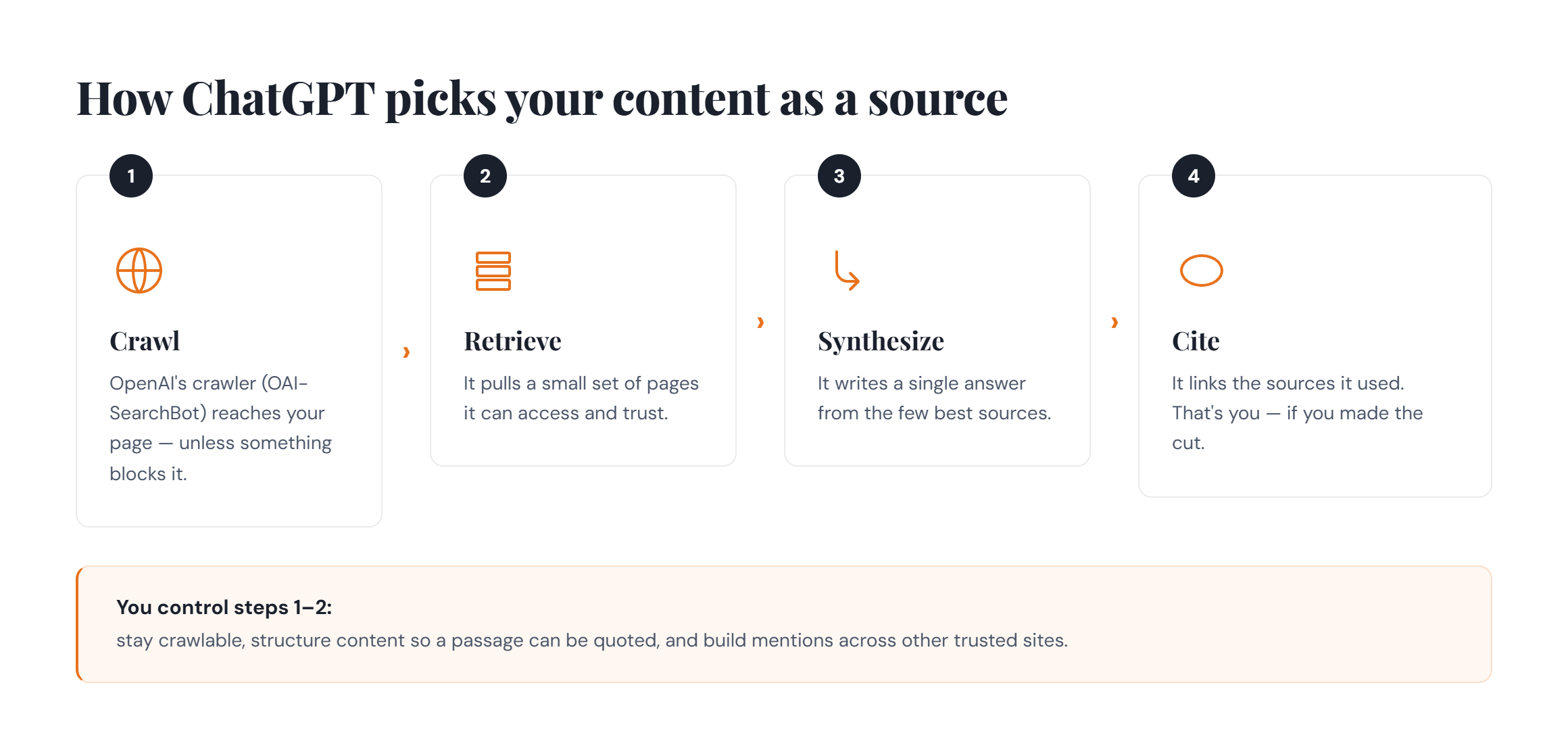
When ChatGPT answers a live question, it pulls a handful of pages it can retrieve, then synthesizes an answer from the few it trusts most. Exactly how it builds that pool is deliberately murky — OpenAI has said it uses its own index and sometimes partners with other search providers. The popular shorthand that “ChatGPT is just Bing” has weakened considerably over the last year, so treat any source that states the mechanism with total certainty as a yellow flag.
What matters for you is the pattern researchers keep observing:
- Citations are spread out, not monopolized. In one large analysis of hundreds of thousands of ChatGPT conversations (Profound), the top ten domains accounted for only about 12% of all citations. There is no oligopoly to break into — specific, factual pages from small sites get cited all the time.
- Consensus beats a single loud page. When the same claim shows up consistently across several credible, independent places, the model treats it as reliable. A July 2025 Pew Research Center study found that most AI summaries cite three or more sources, and that trusted domains (like .gov sites) appeared far more often than their normal search ranking alone would predict.
- Being in the first answer matters. Analyses have found that the first response in a conversation is where source selection is most decisive — later turns cite far less often.
- ChatGPT is stingy with brand mentions. One 2026 review of tens of thousands of AI responses found ChatGPT named brands in well under 1% of answers, versus a much higher rate on a tool like Perplexity. Being one of the few it does name is valuable precisely because it’s rare.
The technical minimum (do this first)
None of the content advice below matters if the model literally can’t read your site.
- Let OpenAI’s crawler in. OpenAI’s own guidance is blunt: any public website can appear in ChatGPT search as long as you aren’t blocking OAI-SearchBot. Check your
robots.txtand your firewall — this is where most small businesses trip up. - Check your CDN isn’t blocking it for you. Cloudflare, for example, began blocking many AI crawlers by default in mid-2025. You may be blocking OpenAI’s bot without knowing it. Verify.
- Render your content server-side. The working assumption among practitioners is that OAI-SearchBot doesn’t run JavaScript. If your key content only appears after a script runs in the browser, it may be invisible to the crawler. Make sure the important text is in the raw HTML.
- Keep your site indexed in Bing. It’s cheap insurance and still appears to feed part of the retrieval pool.
If you do nothing else from this article, do these four things. They’re the price of admission.
The content that actually gets quoted
Once the model can reach you, the goal is to be the easiest, most trustworthy thing to quote for a specific question.
Answer the question first, in plain language. Lead each section with a direct, self-contained answer — the way this article opens with a short answer before the explanation. Models lift clean passages that resolve the question completely. Burying the answer three paragraphs down hands the citation to a competitor who didn’t.
Offer something the model doesn’t already know. If your page just rephrases what’s on Wikipedia, there’s no reason to cite you — the model already has that. Original numbers, first-hand results, a real example from your own work, a price range, a checklist you actually use — that’s “information gain,” and it’s what makes a page worth referencing.
Get mentioned in the places that get cited. Two patterns pay off. First, third-party consensus: reviews, directories, guest articles, and mentions on other credible sites all reinforce that you exist and can be trusted. If you’ve never audited how consistently your business details appear across those listings, our free local SEO audit checks it in about a minute. Second, “best of” and comparison lists — if your business consistently appears in the top few of the roundup articles for your category, ChatGPT tends to mirror those lists when it recommends. Being in the conversation elsewhere is often more powerful than anything on your own site.
Keep it current. Fresh, dated, maintained pages read as more trustworthy than a page that clearly hasn’t been touched in two years.
How to know if it’s working
You can’t manage what you don’t measure, so build a simple habit:
- Write a fixed set of prompts a customer might actually type (“best [your service] in [your city],” “how do I choose a [your service] provider”). Run them in ChatGPT weekly and read the Sources panel to see who gets cited.
- Watch for AI referral traffic in GA4 — links inside AI answers do send real visits.
- Track the basics over time: how often you’re cited, in what position, and whether the mention is accurate.
The honest caveat
Anyone promising guaranteed ChatGPT citations is selling something. Citation behavior is genuinely volatile — the mix of sources these tools favor has been observed swinging dramatically within a matter of weeks. You cannot game a single algorithm here. What you can do is make your business the clearest, best-corroborated, easiest-to-quote answer to the questions your customers ask — and re-check monthly. Do that consistently and your visibility compounds in places your old analytics never showed you.
Want to know if your business is already showing up?
At Veriti Digital, AI search visibility is one of the three things we do — alongside SEO and Google Ads — and it’s still new enough that a little deliberate work goes a long way. If you’d like to see how your business currently shows up across ChatGPT and other AI answers (and where the gaps are), get in touch and we’ll take a look. No account managers, no handoffs — you’ll be working directly with a senior consultant.